On Wednesday 12 August 2026, people across the UK will have the opportunity to witness one of the most impressive solar eclipses visible from Britain for decades.
Around 90% to 96% of the Sun will be covered by the Moon across parts of the UK, depending on location. In London, the partial eclipse is expected to begin at approximately 6.17 pm, reach its maximum at around 7.12 pm, and end at approximately 8.06 pm.
It promises to be a remarkable sight. However, there is one message that should come before everything else:
Never look directly at the Sun during the eclipse without appropriate solar eye protection.
Even when more than 90% of the Sun is covered, the remaining visible portion is still bright enough to cause serious and potentially permanent retinal damage.
As a Consultant Ophthalmic Surgeon, I would strongly encourage anyone planning to watch the eclipse to understand how to do so safely.
Solar Eclipse Eye Safety UK : Why Can a Solar Eclipse Damage Your Eyes?
A solar eclipse does not make sunlight inherently more dangerous.
The problem is that the Sun appears much dimmer during an eclipse. This can make people feel that it is safe to stare at it for longer than they normally would.
It is not.
Intense solar radiation can damage the retina, the light-sensitive tissue at the back of the eye responsible for converting light into the signals that allow us to see.
This type of injury is known as solar retinopathy, sometimes called eclipse retinopathy.
One particularly concerning feature is that the retina does not contain pain receptors. This means retinal damage may be occurring without producing pain or an immediate warning sensation. Symptoms can become apparent several hours later.
Following the 1999 solar eclipse, approximately 70 cases of eclipse-related visual problems were identified in a UK ophthalmic survey. UK Health Security Agency guidance notes that around 40% of affected people had looked at the eclipse for less than one minute.

How to Protect Your Eyes During the Solar Eclipse
1. Use Proper ISO 12312-2 Eclipse Glasses
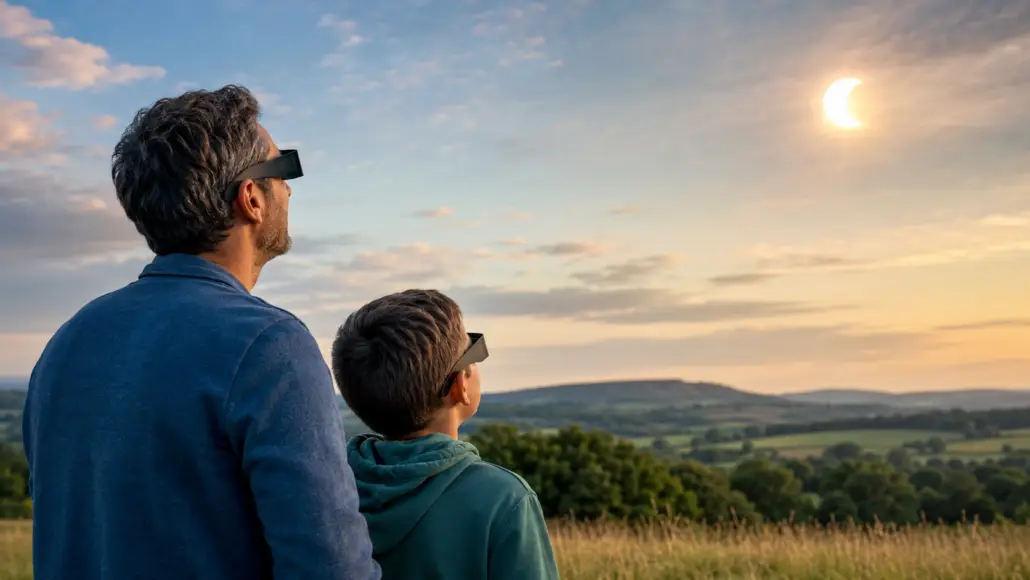
If you want to look directly at the eclipse, use purpose-built solar eclipse glasses or handheld solar viewers that comply with the international ISO 12312-2 safety standard.
Ordinary sunglasses are not sufficient.
Even very dark sunglasses are designed to reduce everyday brightness and glare. They do not provide the level of filtration required for directly viewing the Sun.
Look for eclipse viewers that clearly state compliance with:
ISO 12312-2 or ISO 12312-2:2015
You should also buy them from a reputable supplier rather than relying solely on an ISO logo printed on inexpensive glasses purchased from an unknown online seller.
2. Inspect Eclipse Glasses Before Using Them
Before the eclipse begins, carefully examine your solar viewers.
Do not use them if you notice:
- scratches
- punctures
- tears
- creases affecting the filter
- damaged frames
- filters becoming detached from the frame
If you are unsure whether the glasses are genuine or whether the filter has been damaged, the safest option is not to use them.
3. Put Eclipse Glasses On Before Looking Towards the Sun
Use your eclipse glasses correctly.
First, look away from the Sun.
Put the glasses securely over your eyes.
Only then should you turn towards the Sun.
When you have finished viewing, turn your face away from the Sun before removing the glasses.
This reduces the risk of accidentally exposing your eyes to direct sunlight.
4. Do Not Remove Your Eclipse Glasses During the UK Eclipse
This point is particularly important for the 12 August 2026 UK solar eclipse.
Although this event is a total solar eclipse in parts of Greenland, Iceland and Spain, people in the UK will see a partial eclipse.
Therefore:
There will be no period of totality in the UK when it is safe to look directly at the Sun without appropriate solar filters.
Keep your certified solar viewer in place whenever you are directly looking towards the Sun.
The American Astronomical Society confirms that throughout a partial solar eclipse there is no stage when directly viewing the Sun without a suitable solar filter is safe.
5. Never Look Through Binoculars, Cameras or Telescopes Without Specialist Solar Filters
Eclipse glasses are designed for viewing the Sun directly with your eyes.
They do not make it safe to look through:
- binoculars
- telescopes
- camera lenses
- spotting scopes
- optical viewfinders
These optical devices concentrate solar energy.
Appropriate specialist solar filters must be securely fitted to the front of the optical equipment, before sunlight enters the instrument.
Never put eclipse glasses between your eyes and an unfiltered telescope, binoculars or camera.
If you want to photograph the eclipse using specialist equipment, seek advice from an experienced solar photographer or astronomical organisation and use equipment designed specifically for solar observation.
6. Ordinary Sunglasses Are Not Safe
One of the most common misconceptions surrounding solar eclipses is that very dark sunglasses provide enough protection.
They do not.
UK Health Security Agency guidance specifically warns that ordinary sunglasses, regardless of how dark they appear, do not provide adequate protection when viewing an eclipse.
Avoid using:
- ordinary sunglasses
- multiple pairs of sunglasses worn together
- polarised sunglasses
- photographic film
- CDs or DVDs
- smoked glass
- tinted plastic
- homemade filters
- improvised dark materials
If it has not been specifically designed and verified for solar viewing, do not use it.
What If You Cannot Find Eclipse Glasses?
You do not need to look directly at the Sun to enjoy the eclipse.
In fact, indirect viewing is one of the safest ways to watch it.
Use a Pinhole Projector
A simple pinhole projector allows you to view an image of the Sun without looking towards it.
Make a small hole in a piece of card and allow sunlight to pass through the hole onto a second piece of white card or another surface.
You will see the shape of the partially eclipsed Sun projected onto the surface.
Keep your back towards the Sun while using the projector.
Never look through the pinhole at the Sun.
Try a Colander
A kitchen colander can produce dozens of small projected images of the eclipse.
Stand with your back towards the Sun and allow the sunlight to pass through the holes onto the ground or a piece of paper.
During the eclipse, the projected circles will gradually turn into crescent shapes.
Look Under a Tree
Gaps between leaves naturally act as tiny pinhole projectors.
During a partial eclipse, look at the light patterns projected onto the ground beneath a leafy tree rather than looking towards the Sun itself.
Watch a Professional Live Broadcast
If you cannot obtain appropriate equipment, watching a professional livestream is an excellent alternative.
The Royal Observatory Greenwich is broadcasting the 12 August 2026 eclipse live, allowing people to experience the event without exposing their eyes to the Sun.
Can I Look at the Eclipse if It Is Cloudy?
No.
Clouds are not eye protection.
The Sun may appear considerably dimmer through thin cloud, haze or mist, but enough solar radiation can still reach your eyes to cause injury.
You should follow the same eye-safety precautions regardless of whether the sky appears clear or cloudy.
Are Children at Greater Risk During a Solar Eclipse?
Children should be closely supervised throughout the eclipse.
Their natural curiosity can make them particularly tempted to look directly at the Sun, and younger children may not fully understand why ordinary sunglasses are inadequate.
Adults should:
- provide suitable certified eclipse viewers
- check the glasses fit securely
- inspect the filters beforehand
- demonstrate how to use them
- supervise children continuously while viewing
For very young children, indirect viewing methods or watching a live broadcast may be the simplest and safest option.
What Happens If You Look at a Solar Eclipse Without Glasses?
Looking directly at the Sun without suitable protection can cause solar retinopathy.
Damage typically affects the macula, the central part of the retina responsible for detailed vision.
Because the retina has no pain receptors, you may not immediately realise that damage has occurred.
Possible symptoms include:
- blurred central vision
- a dark or blind spot in the centre of your vision
- distorted vision
- straight lines appearing bent or wavy
- reduced colour perception
- increased sensitivity to light
- difficulty reading or recognising fine detail
Symptoms may develop several hours after exposure rather than immediately. Some people improve over a period of weeks or months, while others can be left with permanent visual impairment.
What Should You Do If Your Vision Changes After Watching the Eclipse?
Do not ignore a change in your eyesight following direct exposure to the Sun.
If you develop blurred vision, distorted vision, a central dark spot or any other new visual disturbance after watching the eclipse, seek prompt assessment from an eye-care professional.
There is no simple home treatment that can determine whether the retina has been damaged.
An ophthalmic examination can assess the retina and macula and help establish the cause of your symptoms.
Solar Eclipse Eye Safety Checklist
Before watching the eclipse tomorrow, remember:
DO
- Use genuine ISO 12312-2 compliant eclipse glasses.
- Inspect your glasses before use.
- Keep your glasses on whenever directly viewing the UK partial eclipse.
- Supervise children carefully.
- Use pinhole projection if you do not have appropriate glasses.
- Use professionally fitted solar filters on telescopes and cameras.
- Seek prompt professional advice if your vision changes afterwards.
DON’T
- Look directly at the Sun with the naked eye.
- Use normal sunglasses.
- Use homemade or improvised filters.
- Look through binoculars, cameras or telescopes without specialist solar filters.
- Assume clouds make direct viewing safe.
- Remove eclipse glasses because the Sun looks almost completely covered.
- Ignore blurred, distorted or altered vision following exposure.
A Message From Consultant Eye Surgeon Mr Vinod Gangwani
The 12 August 2026 eclipse is a fascinating event and one that many families across the UK will understandably want to experience.
The important thing is to enjoy it without unnecessarily risking your eyesight.
Even a thin visible section of the Sun remains extremely bright. In the UK, tomorrow’s eclipse remains partial throughout, so appropriate eye protection is required whenever you look directly towards it.
Prevention is straightforward. Retinal damage may not be.
If you experience any unusual change in your vision after viewing the eclipse, arrange an eye assessment promptly.
About Mr Vinod Gangwani
Mr Vinod Gangwani is a Consultant Ophthalmic Surgeon with extensive expertise in cataract and corneal surgery.
He gained extensive surgical experience at Moorfields Eye Hospital in London, including fellowship training in cataract surgery and complex cataract procedures involving premium intraocular lenses.
He subsequently completed specialist fellowship training in cornea and external eye disease at Moorfields Eye Hospital and King’s College Hospital, London.
Mr Gangwani currently works as a Consultant Ophthalmic Surgeon at Ashford and St Peter’s Hospitals NHS Foundation Trust, where he is also Clinical Lead for cataract microsurgery.
His specialist interests include:
- routine and complex cataract surgery
- astigmatism management during cataract surgery
- reducing dependency on glasses
- refractive lens-based surgery
- multifocal and trifocal intraocular lenses
- toric intraocular lenses
- corneal disease
- lamellar corneal transplantation
Mr Gangwani has presented at international ophthalmology conferences and has published research in peer-reviewed journals including the American Journal of Ophthalmology, Journal of Cataract & Refractive Surgery and British Journal of Ophthalmology.
Concerned About Your Vision?
If you experience blurred vision, distorted central vision, a new blind spot or any other change in eyesight after viewing the solar eclipse, do not simply wait to see whether it disappears.
Arrange a professional eye assessment.
Contact Mr Vinod Gangwani’s team to arrange a consultation or specialist ophthalmic assessment.
This article provides general information and should not replace individual medical advice, diagnosis or treatment.