Specialist Treatments to Protect Vision and Improve Quality of Life
Keratoconus and corneal ectasia are conditions that affect the strength and shape of the cornea, causing it to become thinner and develop an irregular shape. As the cornea changes, it can affect how light enters the eye, leading to blurred vision, increasing astigmatism and difficulty achieving clear sight.
The good news is that advances in corneal treatments mean that many patients can achieve improved vision and better long-term outcomes through a range of specialist treatment options.
Treatment depends on several factors, including:
- The severity of the condition
- Whether the cornea is stable or progressing
- The patient’s age
- The level of visual impairment
- Overall eye health
Early assessment is important because treatment is often most effective before significant progression occurs.
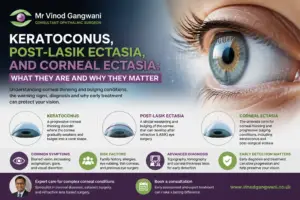
Before exploring treatment options, it helps to understand the conditions themselves. Read our guide on Keratoconus, Post-LASIK Ectasia, and Corneal Ectasia: What They Are and Why They Matter.
Mr Vinod Gangwani is an experienced consultant ophthalmic surgeon specialising in corneal diseases, cataract surgery and refractive lens-based surgery. Having gained extensive experience at Moorfields Eye Hospital, he provides specialist corneal expertise for patients with routine and complex corneal conditions.
How Are Keratoconus and Corneal Ectasia Treated?
There is no single treatment suitable for every patient with keratoconus or corneal ectasia.
Some patients may only require regular monitoring, while others may benefit from treatments designed to improve vision or strengthen the cornea.
The main treatment options include:
- Glasses
- Specialist contact lenses
- Corneal collagen cross-linking
- Intrastromal corneal ring segments
- Corneal transplantation in advanced cases
A specialist corneal assessment helps determine the most appropriate approach.
1. Glasses for Keratoconus and Corneal Ectasia
In the early stages of keratoconus, glasses may provide effective vision correction.
As the cornea begins to change shape, glasses can help correct:
- Short-sightedness
- Astigmatism
- Mild visual distortion
However, because keratoconus involves irregular changes to the corneal surface, glasses may become less effective as the condition progresses.
Patients may notice:
- Frequent prescription changes
- Reduced sharpness of vision
- Difficulty achieving clear focus
When glasses no longer provide satisfactory vision, specialist contact lenses may be recommended.
2. Rigid Gas Permeable Contact Lenses
Rigid gas permeable (RGP) lenses are commonly used for patients with keratoconus because they create a smooth optical surface over the irregular cornea.
Unlike soft contact lenses, RGP lenses maintain their shape when placed on the eye.
This allows light to enter the eye more accurately, improving vision quality.
Benefits of RGP lenses include:
- Improved visual clarity
- Correction of irregular astigmatism
- Better focus compared with standard glasses in many patients
Although RGP lenses can provide excellent vision, some patients may find them less comfortable during the adjustment period.
3. Scleral Contact Lenses
Scleral lenses are larger specialised contact lenses designed to sit over the white part of the eye (the sclera) rather than resting directly on the cornea.
They create a fluid reservoir between the lens and the cornea, which helps:
- Smooth out corneal irregularities
- Improve comfort
- Provide stable vision correction
Scleral lenses are particularly useful for patients with:
- Moderate to advanced keratoconus
- Irregular corneal surfaces
- Contact lens intolerance
Many patients who struggle with traditional contact lenses find scleral lenses provide a significant improvement in both comfort and vision.
4. Corneal Collagen Cross-Linking (CXL)
Corneal collagen cross-linking is a treatment designed to strengthen the cornea and slow or stop progression of keratoconus and corneal ectasia.
The cornea naturally contains collagen fibres that provide structural strength. In keratoconus, these fibres become weaker, allowing the cornea to progressively thin and bulge.
Cross-linking works by strengthening the bonds between collagen fibres.
The main aim of treatment is to:
- Stabilise the cornea
- Reduce the risk of further progression
- Preserve existing vision
It is important to understand that corneal cross-linking is not primarily a vision correction procedure.
Its main purpose is to prevent the condition from worsening.
Patients may still require glasses or contact lenses after treatment to achieve the clearest possible vision.
Who May Benefit From Corneal Cross-Linking?
Corneal cross-linking is generally considered for patients who show evidence of progression.
Factors considered include:
- Changes in corneal shape
- Increasing prescription changes
- Increasing corneal thinning
- Age of the patient
- Overall corneal health
Early diagnosis is important because cross-linking is most effective when there is still sufficient corneal strength and thickness.
5. Intrastromal Corneal Ring Segments (ICRS)
Intrastromal corneal ring segments, sometimes known as corneal ring implants, are small medical devices placed within the cornea to help improve its shape.
The aim is to:
- Reduce corneal irregularity
- Improve visual quality
- Reduce dependence on specialist contact lenses in some patients
ICRS can help flatten areas of corneal steepening and improve the regularity of the corneal surface.
They may be considered for selected patients with keratoconus who:
- Have difficulty tolerating contact lenses
- Have irregular corneal shape
- Are not suitable for other treatment options
A detailed assessment is required to determine whether this procedure is appropriate.
6. Corneal Transplant Surgery for Advanced Cases
In advanced cases of keratoconus or corneal ectasia, where other treatments are no longer effective, a corneal transplant may be considered.
A corneal transplant involves replacing damaged corneal tissue with healthy donor tissue.
There are different types of corneal transplant procedures depending on which layers of the cornea are affected.
These may include:
- Partial thickness corneal transplant
- Full thickness corneal transplant
Corneal transplantation may be considered when patients experience:
- Severe corneal scarring
- Significant vision loss
- Contact lens intolerance
- Advanced corneal thinning
Modern corneal transplant techniques have improved outcomes significantly, allowing many patients to achieve meaningful improvements in vision.
How Do Doctors Decide Which Treatment Is Right?
Treatment decisions are personalised and depend on the individual patient.
During assessment, a corneal specialist will consider:
Disease Progression
Is the cornea stable or continuing to weaken?
Corneal Shape and Thickness
Advanced imaging helps assess:
- Corneal structure
- Areas of thinning
- Changes over time
Vision Requirements
The best treatment approach depends on:
- Current vision quality
- Lifestyle needs
- Work requirements
- Daily activities
Patient Comfort and Preferences
Some patients prioritise maximum vision correction, while others focus on comfort and reducing dependence on contact lenses.
Why Early Specialist Assessment Matters
Keratoconus and corneal ectasia are progressive conditions, meaning they can worsen over time.
Early diagnosis allows specialists to:
- Monitor changes
- Identify progression
- Consider treatments earlier
- Protect long-term vision
Waiting until vision becomes significantly affected may limit available treatment options.
Regular specialist monitoring is particularly important for younger patients, as keratoconus can progress more rapidly during adolescence and early adulthood.
Specialist Corneal Treatment With Mr Vinod Gangwani
Keratoconus and corneal ectasia require careful assessment and a personalised treatment approach.
Mr Vinod Gangwani is a consultant ophthalmic surgeon with specialist experience in corneal diseases, cataract surgery and refractive lens-based surgery.
Having gained extensive professional experience at Moorfields Eye Hospital, he provides tertiary corneal expertise for patients with both routine and complex corneal conditions.
If you have been diagnosed with keratoconus, corneal ectasia, or are experiencing changing vision, a specialist consultation can help determine the most appropriate treatment options for your eyes.