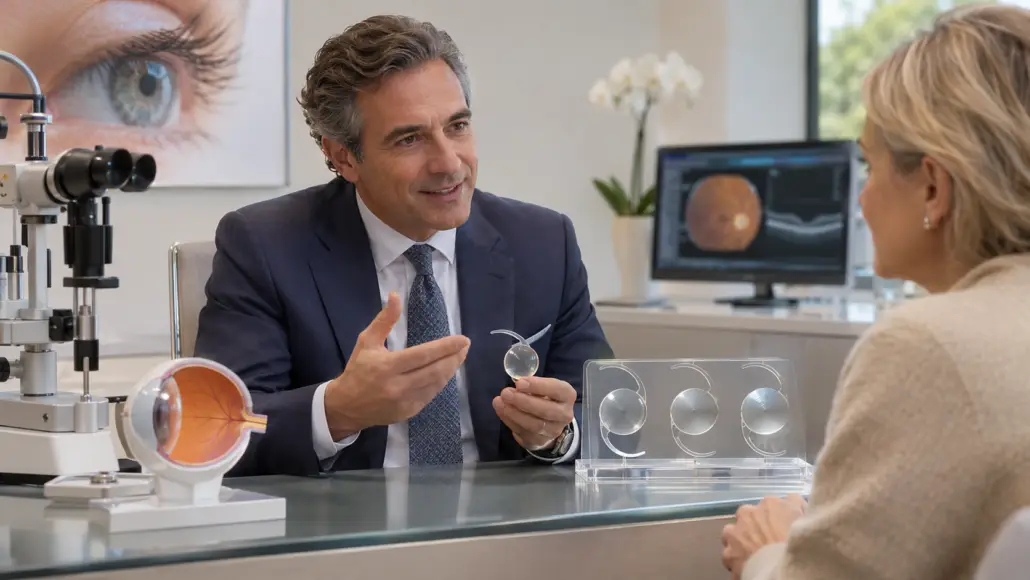
Choosing between Monofocal, EDOF and Trifocal IOLs is an important decision when preparing for cataract surgery. Each intraocular lens offers different benefits for distance vision, reading, computer use and everyday activities, but understanding the differences can help you make a more informed choice.
Imagine waking up in the morning and looking across your bedroom without reaching for your glasses. You pick up your mobile phone, read a message, glance at the clock and begin your day.
For some people, the goal of cataract surgery is simply to restore clearer distance vision. Others hope to reduce their dependence on glasses for everyday activities, including reading, using a computer and driving.
Monofocal, EDOF and Trifocal IOLs offer different approaches to correcting vision following cataract surgery. Each lens design has its own advantages, limitations and potential visual side effects.
Mr Vinod Gangwani, a Consultant Ophthalmic Surgeon specialising in cataract surgery, premium lens implants and corneal disease, explains the key differences to help you understand which option may be most appropriate for your eyes, lifestyle and visual expectations.
Understanding Intraocular Lenses: What Happens During Cataract Surgery?
Inside your eye is a natural lens that helps focus light onto the retina, the light-sensitive tissue at the back of the eye.
Over time, this natural lens can become cloudy, causing a cataract.
Cataracts may make everyday activities increasingly difficult. You might experience blurred vision, increased sensitivity to glare, difficulty driving at night or colours that appear less vibrant.
During cataract surgery, the cloudy natural lens is removed and replaced with a clear artificial intraocular lens, commonly called an IOL.
Unlike your natural lens when you were younger, most artificial lens implants cannot change their focusing power in the same way.
Instead, their optical designs determine the range of distances at which you may see clearly without glasses.
The important question is not simply which lens is the most advanced. It is which lens offers the most appropriate balance between visual clarity, spectacle independence and potential optical side effects for your individual eyes.
Monofocal vs EDOF vs Trifocal IOLs: The Key Differences
Before exploring each option, this comparison provides an overview of what patients can generally expect.
| Feature | Monofocal IOL | EDOF IOL | Trifocal IOL |
| Main purpose | Clear vision at one chosen focal distance | Extended range, especially distance and intermediate | Vision across distance, intermediate and near |
| Distance vision | Typically excellent | Typically excellent | Typically good to excellent |
| Computer vision | Glasses may be needed | Often good without glasses | Often good without glasses |
| Reading small print | Reading glasses usually needed if set for distance | Reading glasses may still be needed | Greater likelihood of reading without glasses |
| Night-time halos and glare | Generally lower lens-related risk | Varies by design; often less than trifocal | Greater risk of halos and other visual disturbances |
| Contrast sensitivity | Generally favourable | Depends on optical design | May be reduced compared with monofocal |
| Spectacle independence | Usually limited to the selected focus | Often improved, particularly at intermediate distances | Generally highest across a broad range of distances |
| Main trade-off | Greater need for glasses | Limited very-near vision | Greater potential for optical side effects |
These are general comparisons rather than guaranteed outcomes. Different models within each lens category can perform differently.
1. Monofocal IOLs: Prioritising Clarity at One Distance
Monofocal lenses are widely used in cataract surgery.
They are designed to provide their strongest focus at one chosen distance, usually far away.
For example, if your monofocal lens is selected to optimise distance vision, you may be able to recognise road signs, watch television and enjoy outdoor scenery with reduced dependence on distance glasses.
However, reading a book, checking a phone or working at a computer may still require spectacles.
Advantages of Monofocal IOLs
Predictable, established optical performance
Monofocal lenses have a long clinical history and generally deliver good visual outcomes when appropriately selected and implanted.
Good image contrast
Because conventional monofocal lenses do not deliberately divide light between several focal points, they generally preserve contrast sensitivity better than multifocal lenses.
Contrast sensitivity is particularly important when distinguishing objects from similar-coloured backgrounds or seeing in low-light conditions.
Lower risk of lens-related halos
Monofocal implants are generally associated with fewer halos and unwanted light effects than trifocal lenses.
This may be important for people who regularly drive after dark.
Suitable for a wider range of patients
Some patients with other eye conditions may be better suited to monofocal lenses than to trifocal implants, depending on their examination findings.
Disadvantages of Monofocal IOLs
The principal limitation is reduced vision at distances outside the chosen focal point.
For example, a monofocal lens optimised for distance does not usually provide the same freedom from reading glasses as a trifocal lens.
It is also important to understand that monofocal does not automatically mean distance-only.
Some patients may choose a near-vision target, while others may be suitable for monovision, where the two eyes are deliberately targeted at slightly different distances.
Monovision requires careful assessment because not everyone comfortably tolerates the difference between their eyes.
Who Might Benefit from Monofocal Lenses?
Monofocal IOLs may be particularly worth considering if you:
- Prioritise image clarity and contrast over freedom from glasses.
- Drive frequently, particularly at night.
- Are comfortable using reading glasses.
- Have eye conditions that make multifocal optics less suitable.
- Prefer a well-established lens design with fewer optical compromises.
The key consideration: Monofocal lenses can provide excellent vision at their intended focal distance, but most patients will still need glasses for certain activities.
2. EDOF IOLs: Extending Your Range of Clear Vision
EDOF stands for Extended Depth of Focus.
These lenses are designed to provide a broader range of useful vision than conventional monofocal lenses, particularly between distance and intermediate viewing distances.
Think about an ordinary working day.
You look across the room during a meeting, turn towards your computer screen, check your car dashboard and glance at a person sitting opposite you.
These activities require your eyes to function comfortably across different distances.
An EDOF lens is designed to help with this transition.
How Do EDOF Lenses Work?
Rather than concentrating vision at a single conventional focal point, EDOF lenses use specialised optical designs to extend the range over which objects can remain acceptably focused.
Different EDOF models achieve this using different optical principles, including wavefront-shaping, refractive or diffractive technologies.
This distinction matters because not every EDOF lens produces exactly the same visual results or side-effect profile.
Advantages of EDOF IOLs
Improved intermediate vision
EDOF lenses are particularly attractive to people who spend significant time using computers, looking at dashboards or undertaking activities at arm’s length.
Reduced dependence on spectacles
Many patients experience greater freedom from glasses for distance and intermediate activities than they would with conventional distance-targeted monofocal lenses.
Potentially fewer visual disturbances than trifocal lenses
Some EDOF designs are associated with fewer halos and unwanted light effects than trifocal lenses.
However, the extent of this advantage depends on the specific lens model and cannot be guaranteed.
A useful balance between visual range and optical quality
For suitable patients, EDOF implants may provide a compromise between the strong single-distance performance of monofocal lenses and the wider near-vision range offered by trifocal lenses.
Disadvantages of EDOF IOLs
EDOF lenses do not necessarily eliminate the need for reading glasses.
You may still need spectacles for small print, reading in poor lighting or tasks requiring very close vision.
Some EDOF designs can also produce halos, glare or reduced contrast sensitivity.
It would therefore be misleading to describe every EDOF lens as free from night-vision side effects.
Who Might Benefit from EDOF Lenses?
EDOF lenses may be worth discussing if you:
- Work extensively on computers or digital devices.
- Want good distance and intermediate vision.
- Would welcome less dependence on glasses but accept that reading glasses may still be needed.
- Prefer to explore an option that may offer fewer optical disturbances than some trifocal lenses.
- Have been assessed as suitable for an extended-range implant.
The key consideration: EDOF lenses can be appealing for modern, screen-based lifestyles, but their main advantage is generally intermediate vision rather than the closest reading distances.
3. Trifocal IOLs: Greater Freedom from Glasses Across Three Distances
Trifocal intraocular lenses are designed to support vision at three main distances:
- Distance: Looking at road signs, watching television or enjoying scenery.
- Intermediate: Working at a computer, cooking or looking at a car dashboard.
- Near: Reading a book, checking messages or viewing other close-up material.
Most conventional trifocal implants use specialised diffractive optics to distribute incoming light between different focal distances.
This can increase the likelihood of performing many everyday tasks without spectacles.
For someone who has relied on glasses for years, the prospect of greater spectacle independence can be particularly attractive.
However, providing several focal distances involves optical compromises.
Advantages of Trifocal IOLs
A broader range of unaided vision
Trifocal implants are designed to provide useful vision across distance, intermediate and near ranges.
Greater potential for spectacle independence
For appropriately selected patients, trifocal lenses generally offer the greatest opportunity among these three categories to reduce dependence on glasses across multiple everyday tasks.
Improved near vision compared with EDOF lenses
Comparative clinical research has found that trifocal implants generally provide better unaided near vision than EDOF implants.
This can be especially relevant if reading without glasses is a major priority.
Convenience for an active lifestyle
Some people particularly value the ability to move between reading, computer work and distance activities without frequently changing spectacles.
Disadvantages of Trifocal IOLs
Halos and glare
Trifocal lenses are associated with a higher likelihood of visual effects such as halos around lights, glare or starbursts compared with conventional monofocal lenses.
These symptoms may be especially noticeable when looking at headlights or streetlights after dark.
Their frequency and severity vary considerably between patients and lens designs.
Potential reduction in contrast sensitivity
Because light is distributed across multiple focal points, some trifocal lenses may reduce contrast sensitivity compared with monofocal implants.
A period of visual adaptation
The visual system may take time to adjust to the way a trifocal lens presents images.
Some patients find their visual disturbances become less noticeable over time. Others continue to experience symptoms.
Adaptation is not guaranteed.
Not suitable for every eye
Certain corneal or retinal conditions, irregular astigmatism and other visual abnormalities may affect suitability for trifocal implants.
A detailed examination is essential before deciding whether these lenses are appropriate.
Who Might Benefit from Trifocal Lenses?
Trifocal IOLs may be worth considering if you:
- Strongly wish to reduce dependence on glasses for reading and everyday activities.
- Want useful distance, intermediate and near vision.
- Understand and accept the possibility of halos and glare.
- Have suitable ocular health and realistic expectations.
- Are comfortable with the possibility that spectacles may occasionally still be needed.
The key consideration: Trifocal lenses offer greater potential freedom from glasses, but that benefit must be balanced against a higher likelihood of unwanted optical effects compared with conventional monofocal lenses.
Which Lens Is Better for Driving at Night?
Night driving is one of the most important lifestyle factors to consider when selecting a cataract lens implant.
Picture driving along an unfamiliar road on a rainy evening.
You need to distinguish road markings, recognise pedestrians and respond to oncoming headlights.
Good visual acuity is important, but so are contrast sensitivity and the ability to tolerate glare.
Monofocal lenses
Conventional monofocal IOLs generally have the lowest risk of lens-related halos among the three categories.
For patients who frequently drive at night, this may make them a particularly attractive option.
EDOF lenses
Some EDOF designs offer a favourable balance between useful intermediate vision and fewer visual disturbances than trifocal lenses.
However, diffractive and non-diffractive EDOF designs do not necessarily perform alike.
Trifocal lenses
Trifocal implants may make halos around headlights more noticeable.
This does not mean everyone with a trifocal lens will struggle to drive at night. Many patients function satisfactorily, but some experience persistent visual disturbances.
If night driving is central to your work or lifestyle, make this a priority during your cataract consultation.
The most suitable lens should be selected after considering your eye health, visual needs and tolerance of potential optical side effects.
Can You Read Without Glasses After Cataract Surgery?
One of the most common questions about premium lens implants is whether they can eliminate reading glasses.
The answer depends on the lens, the surgical target and the individual patient.
With a distance-targeted monofocal lens, reading glasses will usually be necessary for close work.
With an EDOF lens, many patients enjoy useful computer vision without glasses, but small print and close reading may still require spectacles.
With a trifocal lens, the probability of reading without glasses is generally higher, although some people still need spectacles for very fine print or challenging lighting conditions.
No lens implant can guarantee complete spectacle independence.
For example, even with a trifocal implant, residual prescription error, dry eye, other ocular conditions or particular visual tasks can affect the final result.
The best approach is to define what matters most to you before selecting the lens.
Does Having Astigmatism Affect Your Lens Choice?
Yes. Astigmatism is an important part of planning cataract surgery.
Astigmatism commonly occurs when the cornea has a different curvature in one direction than another, causing light to focus unevenly.
If significant corneal astigmatism remains uncorrected after surgery, it may reduce the quality of vision achieved with any lens type.
Some IOLs are available in toric versions, designed to correct suitable amounts of regular corneal astigmatism.
Toric technology can be incorporated into different lens categories, including monofocal and certain EDOF and trifocal implants.
However, toric lenses do not correct every form of astigmatism, particularly when the corneal shape is irregular.
Mr Gangwani has specialist expertise in cataract surgery, astigmatism management and corneal disease, allowing these factors to be considered together when planning treatment.
What If You Have Dry Eyes, Corneal Disease or Another Eye Condition?
Not every patient is an appropriate candidate for a premium lens implant.
Conditions affecting the surface, cornea, retina or other structures of the eye can influence visual quality after surgery.
For example, significant dry eye may affect the accuracy of preoperative measurements and cause fluctuations in vision.
Corneal scarring or irregularities can distort the light entering the eye.
Certain retinal conditions can reduce contrast sensitivity or limit the visual improvement possible with surgery.
These factors are particularly important when considering trifocal lenses, which rely on the eye’s optical system providing a sufficiently high-quality image.
A monofocal lens may sometimes be more appropriate, although the decision must be individualised.
For patients with both cataracts and corneal problems, specialist assessment can be especially valuable.
Mr Vinod Gangwani’s expertise in both cataract surgery and corneal disease supports a comprehensive assessment of lens suitability, rather than considering the cataract in isolation.
Are Premium Lens Implants Worth the Additional Cost?
Premium lens options such as EDOF and trifocal IOLs may involve additional costs compared with conventional monofocal implants.
But a more expensive lens is not automatically a better lens for every patient.
Its value depends on whether the potential benefits align with your visual priorities.
For someone who frequently works on a computer, improved intermediate vision may be particularly valuable.
For someone who enjoys reading and wants greater freedom from spectacles, a trifocal lens may be worth considering.
However, if night driving, contrast sensitivity or existing ocular disease is the overriding concern, a conventional monofocal lens may be the more appropriate option.
There is also a difference between reducing the need for glasses and eliminating that need entirely.
Any financial decision should be based on realistic expectations, a detailed clinical assessment and a clear explanation of the available options.
How Does Mr Vinod Gangwani Help Patients Choose the Right Cataract Lens?
Choosing an IOL requires more than deciding whether you prefer distance, computer or reading vision.
It involves evaluating the health and optical characteristics of your eyes alongside your daily activities.
Mr Vinod Gangwani is a Consultant Ophthalmic Surgeon specialising in cataract surgery, premium intraocular lens implants and corneal disease.
He is a consultant at Ashford and St Peter’s NHS Foundation Trust, where he serves as Clinical Lead for cataract microsurgery.
With experience of more than 9,000 cataract operations, Mr Gangwani brings extensive surgical experience to the assessment and treatment of cataracts, including complex cases.
He also sees private patients across six hospitals and clinics in Surrey and London.
During a specialist cataract assessment, important considerations may include:
- Your visual priorities: Understanding how much time you spend driving, reading, using digital devices and carrying out close-up activities.
- Eye measurements: Assessing the eye’s dimensions and corneal characteristics to help calculate the appropriate lens power.
- Corneal health: Identifying dry eye, irregularities or corneal conditions that may influence visual outcomes.
- Other eye conditions: Considering factors such as macular health or glaucoma that may affect lens suitability.
- Expected benefits and limitations: Discussing what each lens design may realistically achieve and where glasses might still be needed.
- Potential side effects: Explaining the possibility of halos, glare, contrast changes and other relevant surgical risks.
The aim is to reach an informed decision that reflects both your visual needs and your individual eye health.
Five Questions to Ask Before Choosing Your Cataract Lens Implant
Before making a decision, consider discussing these questions with Mr Gangwani:
1. Which activities matter most to my vision?
Is your priority driving, reading, computer work or reducing your overall dependence on spectacles?
2. How healthy are my corneas and retina?
Underlying eye conditions can influence the safety and suitability of different optical designs.
3. How might this lens affect my night vision?
Ask about halos, glare, contrast sensitivity and the specific lens being considered.
4. Will I still need glasses?
Understand which activities may still require spectacles, even if you choose a premium implant.
5. What happens if my vision is not exactly as expected?
Ask about residual prescription error, postoperative care, potential additional treatment and the limitations of the proposed procedure.
These questions can help you make a decision based on informed expectations rather than marketing claims.
Frequently Asked Questions About Monofocal, EDOF and Trifocal IOLs
What is the main difference between monofocal, EDOF and trifocal lenses?
Monofocal lenses provide their strongest focus at one chosen distance. EDOF lenses extend the range of useful vision, particularly for distance and intermediate tasks. Trifocal lenses are designed to provide vision across distance, intermediate and near ranges, but can cause more optical disturbances.
Are trifocal lenses better than monofocal lenses?
Not necessarily. Trifocal lenses generally provide greater freedom from glasses, particularly for close work. Monofocal lenses generally offer favourable contrast sensitivity and fewer lens-related halos. The better option depends on your eyes and lifestyle.
Are EDOF lenses better than trifocal lenses?
Neither category is universally superior. EDOF lenses are often attractive for distance and computer vision, while trifocal lenses generally offer better unaided near vision. Night-vision effects vary between designs and individual patients.
Can I drive at night with trifocal IOLs?
Many patients can drive at night after receiving trifocal lenses, provided they meet the relevant driving vision requirements. However, halos and glare may be more noticeable, and some patients find these symptoms troublesome. Discuss your night-driving needs before surgery.
Will I need reading glasses with EDOF lenses?
Possibly. EDOF lenses can reduce dependence on glasses for distance and intermediate activities, but small print and very close reading often still require spectacles.
Can cataract lens implants correct astigmatism?
Certain toric intraocular lenses can correct suitable regular corneal astigmatism. Toric versions exist within several IOL categories. The appropriate choice depends on corneal measurements and other clinical factors.
How long do intraocular lens implants last?
Intraocular lenses are generally intended to remain in the eye permanently and do not normally need routine replacement. However, complications or changes in the eye may occasionally require further treatment or, rarely, lens exchange.
Can I have different types of lenses in each eye?
Some patients may benefit from a carefully planned combination of lens designs or different refractive targets. However, this is not suitable for everyone and requires specialist assessment and discussion of the potential compromises.
Making the Right Decision for Your Eyesight
When comparing monofocal vs EDOF vs trifocal IOLs, there is no single lens that offers the best outcome for every patient.
Monofocal implants may suit someone who values contrast, clarity and lower risk of optical disturbances.
EDOF implants may appeal to someone who wants greater freedom from glasses for distance and computer-based activities.
Trifocal implants may appeal to someone whose main priority is reducing spectacle dependence across distance, intermediate and near vision.
The right decision depends on your eye health, visual expectations, lifestyle and willingness to accept the limitations of each optical design.
The most important step is not choosing the lens that promises the greatest freedom from glasses.
It is choosing the lens that gives you the most appropriate vision for the life you lead.
Book a Personalised Cataract Lens Consultation with Mr Vinod Gangwani
If you are considering cataract surgery and would like to understand whether monofocal, EDOF or trifocal lenses could be suitable for you, arrange a specialist consultation with Mr Vinod Gangwani.
With extensive experience in cataract microsurgery, premium lens implants and complex corneal conditions, Mr Gangwani provides specialist assessment to help patients understand their options and make informed decisions.
Whether your priority is clearer distance vision, improved computer vision or greater independence from reading glasses, the first step is to understand what is achievable for your individual eyes.
Book your cataract consultation with Mr Vinod Gangwani today.
Visit https://vinodgangwani.co.uk/ to find out more and enquire about an appointment in Surrey or London.
Medical information: This article provides general educational information and is not a substitute for individual medical advice. Lens suitability, potential risks and expected outcomes should always be discussed with a qualified ophthalmic surgeon. Contact Mr Vinod Gangwani for a detailed eye examination.